
An automated business is a company in which clearly defined workflows move from a trigger to a result through data, rules, actions and planned human oversight. It can automate recurring administrative, customer, document and internal coordination processes, while leaving ambiguous, sensitive or legally significant decisions to people. A Belgian SME is usually ready when its repetitive tasks follow a reasonably stable sequence, the required data is reliable and accessible, and one person can own the process. Choose a first process by its frequency, stability, operational burden, error risk and measurability—not by the popularity of a SaaS tool. A sustainable approach is to observe the workflow, establish a baseline, automate a limited flow, monitor exceptions and expand only after the process proves reliable.
Automated business: an operational definition for an SME
The phrase automated business can suggest a company run entirely by software. That is rarely a useful definition for a small or medium-sized business. A better starting point is the workflow itself: what starts the process, which information is needed, what rules determine the next step, what action follows, and who intervenes when the standard path no longer applies.
For example, a new customer request might arrive through a form. The system records the contact details, checks whether required fields are present, creates a lead, alerts the appropriate person and sends a confirmation. If the request contains an unusual requirement or incomplete information, it is routed to a human instead of being processed silently.
This is different from automating a single task. Automatically generating an email is task automation. Automatically receiving a request, validating it, creating a record, notifying the right person, tracking the outcome and handling exceptions is process automation. A broadly automated business has many such processes connected to its operating model, with clear ownership and monitoring.
The essential components of a complete automated workflow.
| Component | Practical question |
|---|---|
| Trigger | What starts the workflow? |
| Input data | Which information must be available? |
| Rules | How is each standard case treated? |
| Action | What does the system create, send or update? |
| Exception | When must the normal path stop? |
| Human control | Who reviews, approves or takes over? |
The human control point matters as much as the automated action. A workflow without ownership can continue producing incorrect records, messages or decisions long after its original configuration has become unsuitable. Before implementation, document the normal route, the exception route and the person responsible for both.
What an automated business can handle every day
Most SMEs should begin with recurring flows that are visible and bounded. Suitable candidates often include collecting information from forms, transferring data between sales and administration, generating standard documents, sending status notifications, following up with customers and coordinating routine back-office work.
- Information collection: validate a form, classify a request and store the data in a shared record.
- Team handovers: notify the next person, assign responsibility and record the date of the transfer.
- Document generation: create a quotation, confirmation or internal summary from approved data.
- Customer follow-up: send a reminder, update a status or ask for missing information.
- Administrative operations: reconcile routine information, prepare reports or flag overdue items.
Rule-based automation is deterministic. If a form contains the required fields, the record is created; if an invoice is overdue, a task is assigned. This type of automation is usually easier to test because the expected outcome can be stated in advance.
AI-assisted automation is less predictable. An AI system may classify a message, extract information from a document or draft a reply, but its output needs a control method suited to the consequences of an error. A draft for internal review can follow a lighter process than a contractual message, a financial instruction or advice that could create legal exposure. The AI automation service can help you define where AI fits and where a human validation step should remain.
Some situations are poor candidates for full automation. They include cases with ambiguous instructions, unstable source data, significant legal responsibility or a relationship that depends on tact and contextual judgement. Automation may still prepare information or suggest a next step, but the final decision should remain with a qualified person.
SaaS tools, automation and business applications: three levels to distinguish
Using a CRM, accounting platform, project management tool or document tool does not automatically make a business automated. These products may centralise information while leaving every important action dependent on someone remembering what to do next.
Three levels of digital process maturity in an SME.
| Level | How it works | Main limitation |
|---|---|---|
| Manual SaaS use | People enter, check and move information themselves. | The process depends on individual habits. |
| Connected tools | Applications exchange selected data or trigger actions. | The overall workflow may lack ownership and exception handling. |
| Unified automated process | Triggers, rules, actions, monitoring and handovers are defined together. | The process requires maintenance and periodic review. |
A useful test is to ask what happens when the person responsible is absent, changes role or forgets one step. If a request remains invisible, a document is not generated, or nobody knows how to recover an error, the company has software support but not yet a dependable automated process. The article When SaaS Is No Longer Enough for a Small Business helps assess when the limits of a standard product justify a more adapted solution.
The objective is to make the intended sequence dependable, visible and transferable. A person should be able to understand what the process did, what it could not do and what action is required next.
Signs that an SME is ready for automation
Readiness is operational rather than technological. A company can be ready to automate one workflow while remaining unprepared for a broader transformation. Assess each process separately.
- The task is repeated often enough for design and maintenance work to be justified.
- The sequence is stable: the same input generally leads through the same stages.
- The necessary data exists, can be accessed and has a shared meaning across people and systems.
- A named process owner can approve the rules, review exceptions and track results.
- The business understands the cost of an error and has identified which steps require human approval.
- The expected outcome can be observed through a quality, completion, exception or processing-time measure.
Data quality is often the limiting factor. If one employee records a customer as a company and another records the same information as a contact, a connected workflow may spread the inconsistency faster. Before automating, agree on field definitions, required information, ownership and the source that should be treated as authoritative.
Responsibility must also be explicit. The process owner does not need to build the integration, but must be able to answer whether the rules still reflect the business, whether exceptions are resolved and whether access rights remain appropriate.
How to choose a first process without creating an IT project
Start with a short list of recurring workflows rather than a company-wide wish list. Compare them using practical criteria: frequency, stability, effort, error risk, data reliability, customer impact and ease of measurement. A process that is frequent but constantly changing may be less suitable than a less visible process with a stable sequence and clear output.
Criteria for selecting a first SME automation process.
| Criterion | Favourable signal |
|---|---|
| Frequency | The flow recurs regularly. |
| Stability | The steps and rules rarely change. |
| Operational effort | People spend meaningful time repeating the work. |
| Risk | Errors are detectable and containable. |
| Data | Inputs are structured and accessible. |
| Measurement | The result can be observed before and after launch. |
Choose a limited flow with a visible result. For instance, you might automate the handling of incoming service requests without changing the entire customer support model. Define what success means before development begins: fewer missed handovers, more complete records, shorter processing delays or a higher proportion of requests correctly routed.
Establish a baseline before launch so that the comparison is meaningful. The Baseline: How to Prepare Your Benchmark Before Launch explains how to structure that reference point. Also define stop rules and manual recovery: when should the automation pause, who is alerted, and how can the team complete the workflow without losing data?
When speaking with a supplier, ask how connections, credentials, permissions, errors and future changes will be documented. Request a clear explanation of where data is stored, which account owns each integration, how failed actions are identified and what happens if a connected service changes its interface. These questions protect the business from an automation that only one person knows how to operate.
What a sustainable automated business looks like after launch
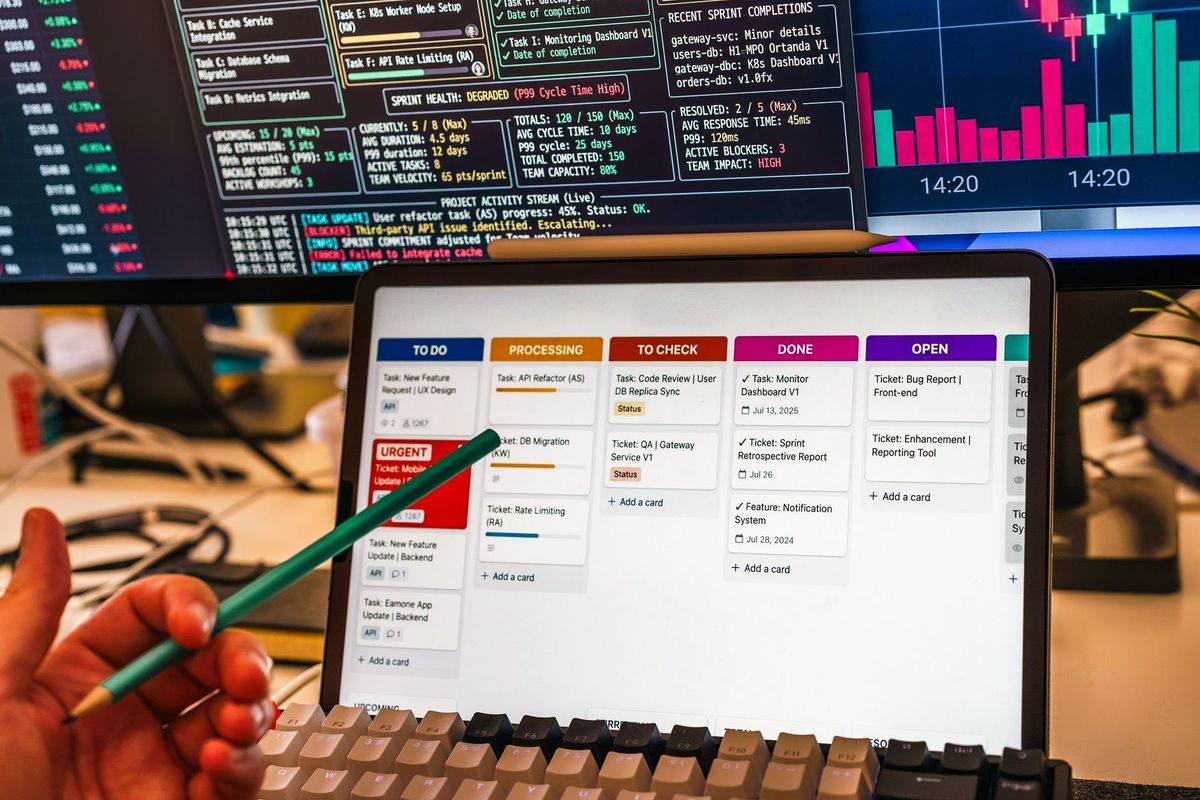
Launch is the beginning of operational ownership. Review whether the process produces accurate results, whether exceptions are increasing, how often people intervene and how long cases take to complete. Time saved is useful, but it is not sufficient. A faster process that creates duplicate records or sends unsuitable messages may reduce visible effort while increasing business risk.
Maintenance should cover integrations, business rules, user permissions, data definitions and any AI models or prompts involved. Staff changes are also relevant: remove access when roles change, update ownership and ensure that a new employee can understand the workflow from its documentation.
Schedule a periodic review with a specific decision: extend the process, correct it, replace a component or make part of it manual again. Returning a sensitive step to human control is not a failure. It can be the correct response when the data, risk or business context has changed.
A practical roadmap is progressive: observe the current workflow, make the data and rules reliable, automate a bounded process, control the results, then extend the approach. If the process needs a dedicated interface rather than another collection of disconnected tools, custom internal tools may provide a clearer operating environment.
Frequently asked questions
What is an automated business?
An automated business is an SME whose defined workflows can move from a trigger to a result using structured data, rules and actions, with human supervision for approvals and exceptions. It is a way of operating, not a list of software subscriptions.
What is the difference between an automated business and using SaaS tools?
SaaS tools provide capabilities such as customer records, accounting or task management. An automated business connects those capabilities into an owned workflow with defined rules, monitoring, exception handling and recovery procedures. If the process stops when one person forgets a step, it is not fully operationalised.
Which processes can a Belgian SME automate first?
Start with recurring and measurable work such as collecting request details, routing enquiries, generating standard documents, sending reminders, synchronising records and preparing routine administrative reports. Avoid beginning with decisions that are ambiguous, legally sensitive or dependent on unstable information.
What are the signs that an SME is ready for automation?
The strongest signs are a stable sequence, sufficient recurring volume, reliable and accessible data, a named process owner, a measurable result and a clear plan for human review. Readiness can exist for one workflow even if other parts of the company still need clarification.
Does an SME need a custom business application to automate its processes?
No. A well-configured existing tool may be sufficient when the workflow is standard and the required connections are reliable. A custom application becomes more relevant when the process crosses several tools, requires a specific interface, has unusual rules or needs stronger control than standard SaaS can provide.