
B2B site redesign
Nallian
How we rebuilt Nallian's B2B SaaS site from a legacy Joomla installation to a custom-built platform that loads in less than a second and scores 95 on Google Lighthouse.
Customer
Nallian
Sector
B2B SaaS: Air Cargo Software
Scope
Complete redesign of the site
Year
2026
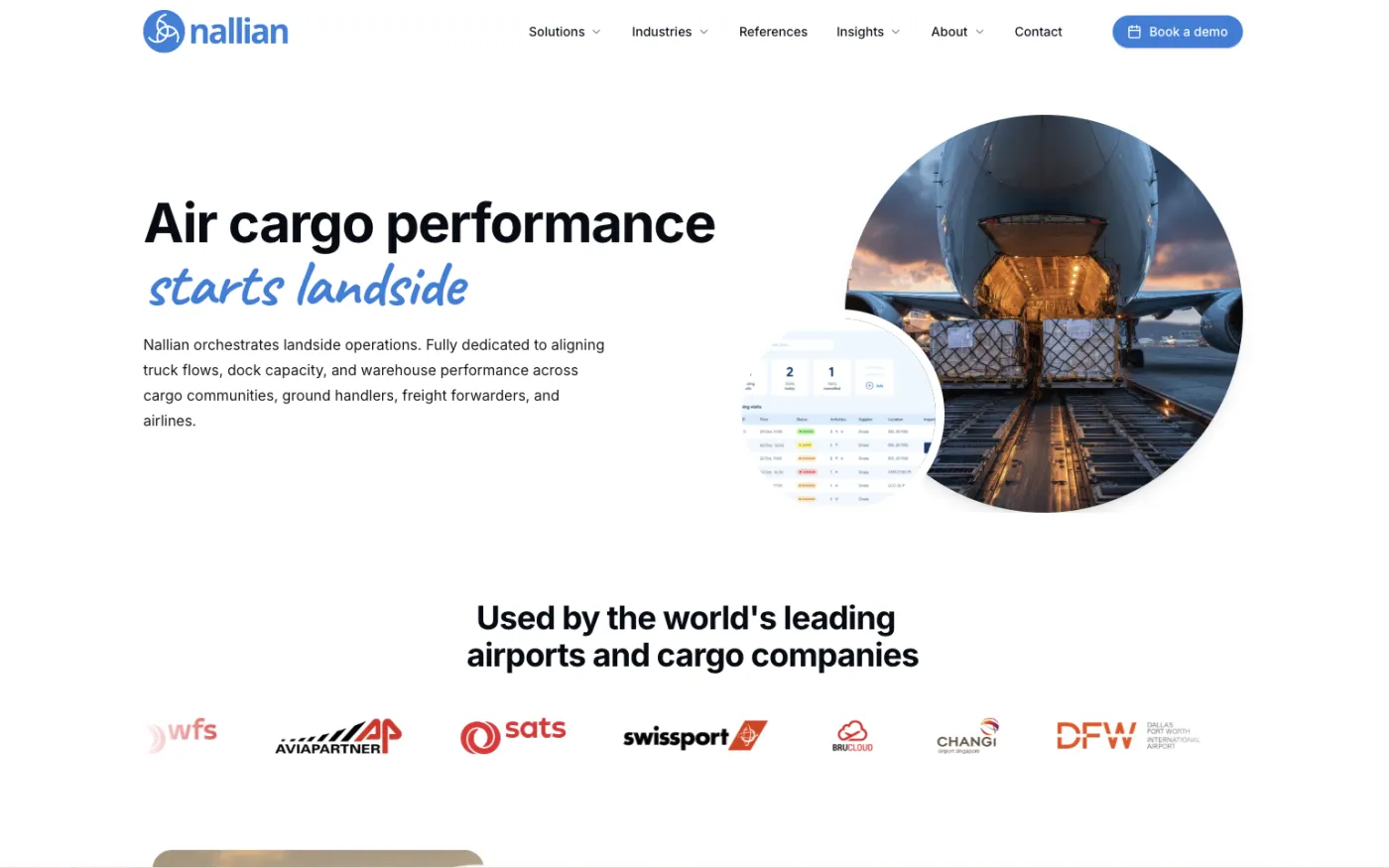
Custom platform developed on Laravel, Filament and Livewire. Lighthouse score increased from 61 to 95 out of 100. Total editorial autonomy for the client team. Delivered on time, June 3, 2026.
Client: Nallian, a Belgian B2B SaaS publisher in air freight software.\ Project: a complete overhaul of the site, from a legacy Joomla installation to a custom platform.\ Result: Lighthouse score increased from 61 to 95 out of 100, loading in less than a second, total editorial autonomy.
At Nallian, we design solutions trusted by the world's largest airports, handling operators and logistics players. But our website no longer reflected this level of excellence. This redesign ensures that our first impression matches the quality of what we actually deliver.

Jean Verheyen
CEO, Nallian
At a glance
95 / 100
Google Lighthouse score on online homepage, compared to 61 on legacy site
< 1 seconde
Loading time on mobile and desktop
100%
Editorial autonomy for the Nallian marketing team
0 plugin
Each feature developed specifically for Nallian
About Nallian
Nallian is a Belgian software publisher based in Brussels. Their solutions are used by some of the world's largest air cargo hubs, including Brussels Airport, Singapore Changi and Amsterdam Schiphol, to orchestrate trucks, dock slots, compliance checks and all the operational details that decide whether cargo moves or gets stuck.
Their problem, at the start of 2026, was simple: the website no longer reflected the company.
A product from 2026, a site from another era
When Joke Aerts, Marketing Director of Nallian, showed us the existing site, the gap was obvious. The site ran on an old Joomla installation with the YOOtheme builder. Every page felt heavy, generic, and dated. The kind of site that makes you doubt the maturity of the company behind it.
The numbers told the same story. The old Joomla homepage scored 61 out of 100 in Google Lighthouse, well below the threshold considered acceptable for a modern B2B site. Loading times left something to be desired. The viewing experience seemed frozen in another decade.
For a B2B SaaS publisher in a competitive niche like air cargo software, this gap is a commercial handicap. When competitors find themselves in the same call for tenders, the first impression is not decided in a meeting. It is decided in the first seconds a prospect visits the home page.
Joomla itself had become a liability. Years of accumulated plugins, theme updates and content layers had transformed the platform into a cumbersome package that no longer offered the necessary flexibility and usability.
Old vs new, at a glance
| Dimensions | Old Joomla site | New custom platform |
|---|---|---|
| Platform | Joomla + builder YOOtheme | Custom Laravel, Filament, Livewire |
| Lighthouse Score | 61 out of 100 | 95 out of 100 |
| Home page loading time | Several seconds | Less than a second |
| Design | Generic builder template | Designed section by section for Nallian |
| Content versioning | None | Complete history with one-click backtracking |
| Image management | Manual resizing, multiple uploads | A single upload, all variants automatically generated |
| Third-party plugins | Multiple dependencies | None |
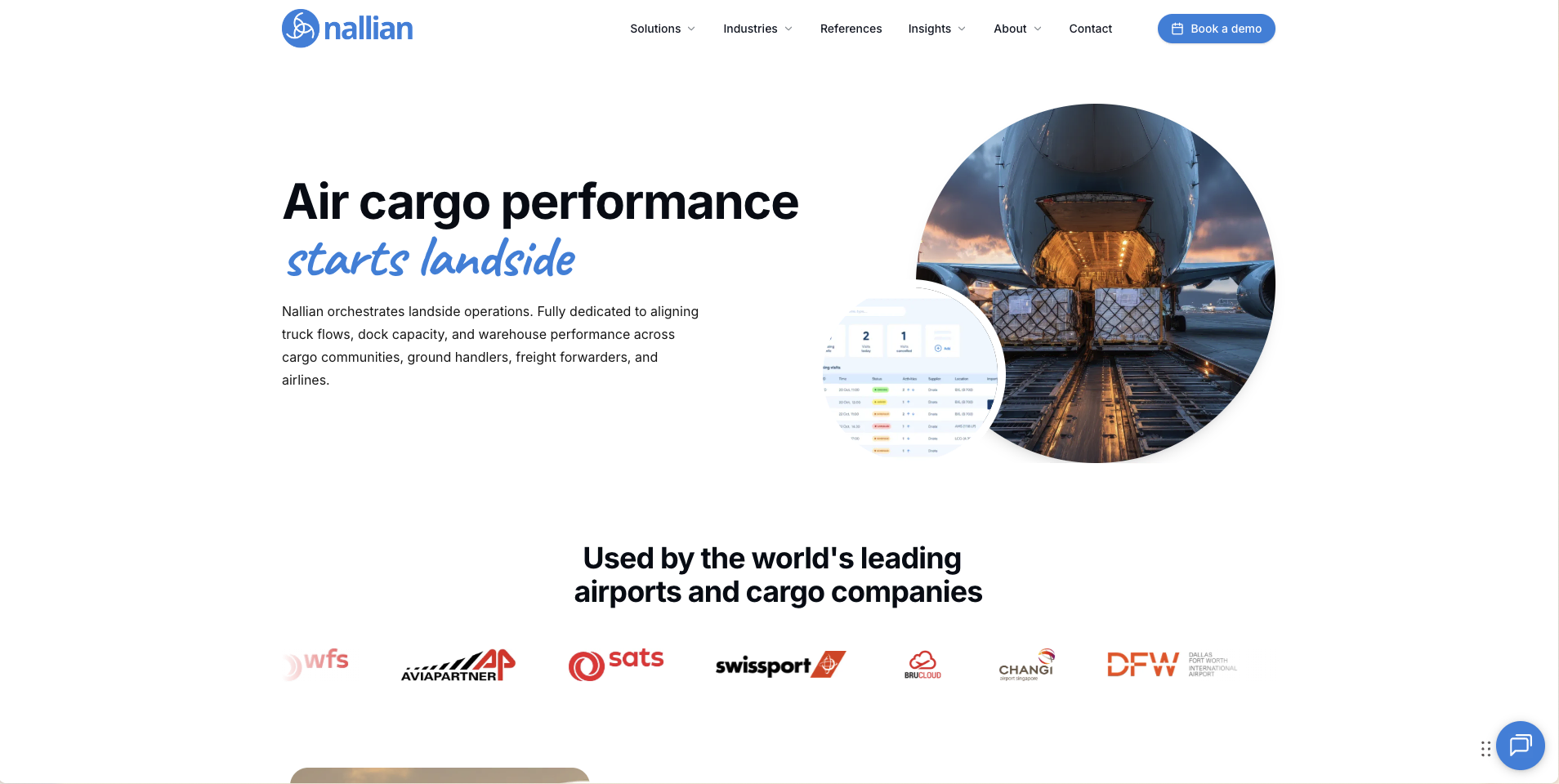 Before After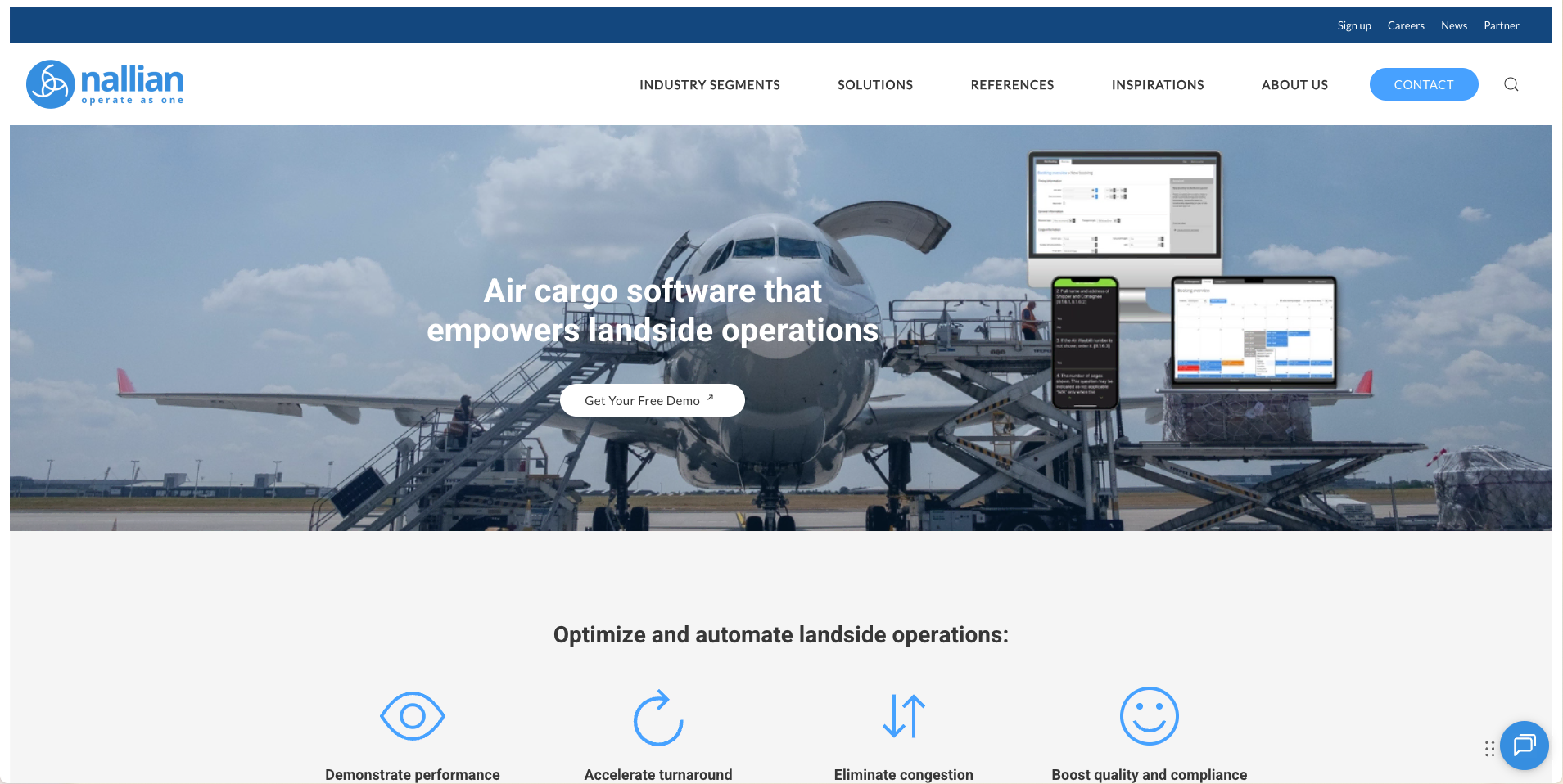
What we wanted to build
Three priorities emerged from initial conversations with Nallian:
- The site must finally look like the business. No more credibility gap. The visual experience must match the quality of what Nallian sells. 2. The site must be fast. Not "fast enough", but measurably fast, even on mobile, even on unstable airport WiFi. 3. The team must be in charge. Joke and his colleagues should be able to publish, update and experiment without ever having to ask us.
Without it, a new site would have only replaced one frustration with another.
We made three commitments. Here's how each came to fruition.
Commitment one: a custom B2B site, not a template
A custom B2B site is designed specifically for a company, around its positioning, its audience and its content strategy. This is the opposite of a template-based site, where a generic theme is re-dressed with new colors and a new logo, or an AI-generated site that looks successful but lacks soul.
The easy route would have been to take a beautiful SaaS template, inject Nallian's branding into it and deliver in three weeks. We did not propose this path.
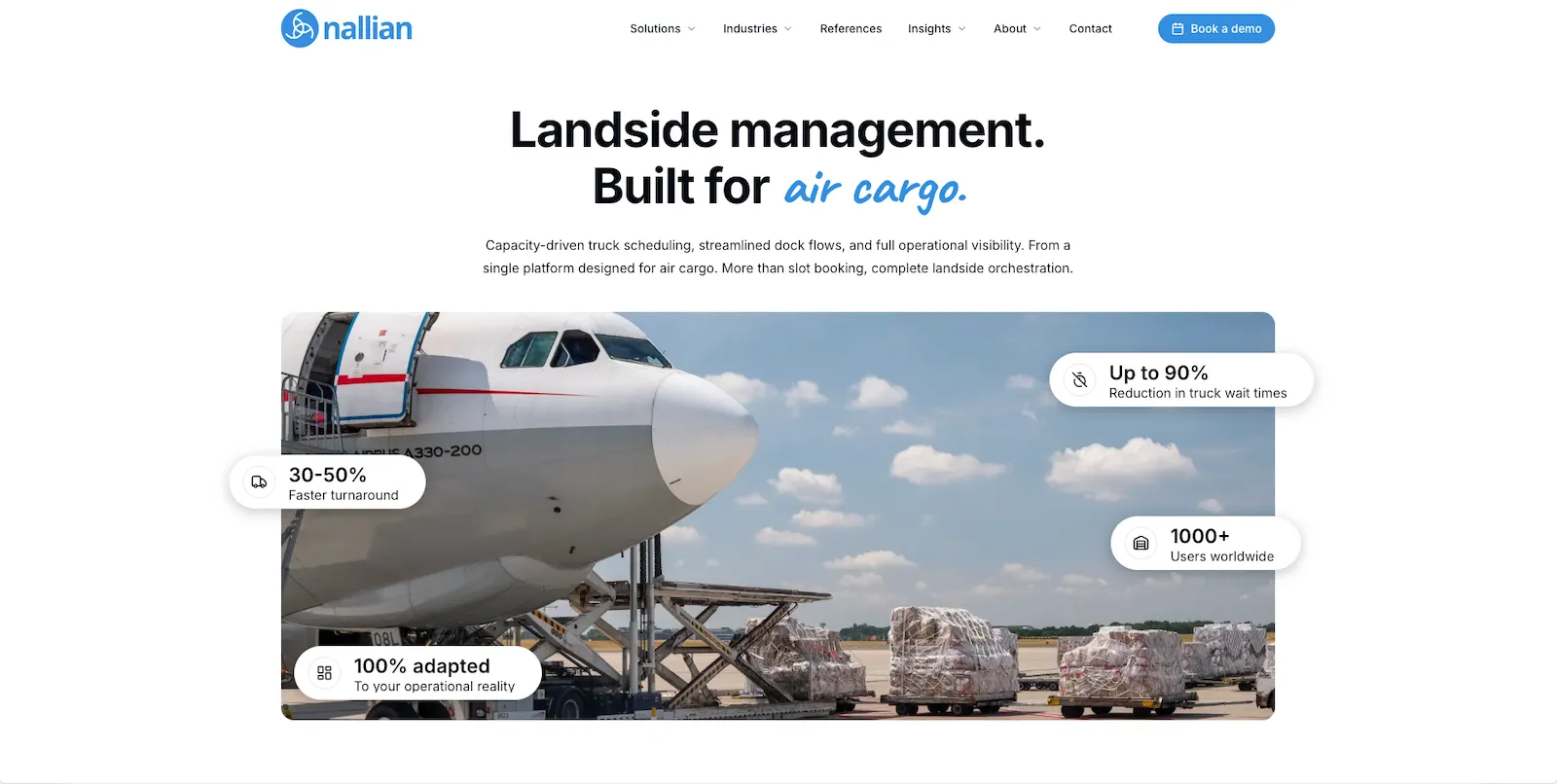
Instead, we designed each section of the site specifically for Nallian: their tone of voice, their visual language, their audience, their positioning in the air cargo software world. The wireframes were validated section by section, in dialogue with Joke, before a single line of code.
The result is a site that doesn't look like a B2B template. He looks like Nallian.
The new site reflects who we are much better. It tells our story more clearly, it’s easy to navigate, it’s fresh and modern. He's more Nallian.

Joke Aerts
Directrice Marketing, Nallian
That last sentence, “he’s more Nallian,” sums up the whole project. A custom B2B site redesign is not a matter of decoration. It's a company that's finally becoming recognizable in a crowded category.
(More details on the balance between custom crafting and AI tools below: see Where AI helped, and where it didn't belong.)
Commitment two: speed as a competitive advantage
Website speed is no longer a technical detail. It is a credibility signal and a conversion lever.
When a CTO or purchasing manager arrives on your B2B site and it takes several seconds to appear, they form a judgment about your company before reading a single word. In B2B SaaS, where buyers compare three providers in parallel tabs, this judgment costs contracts.
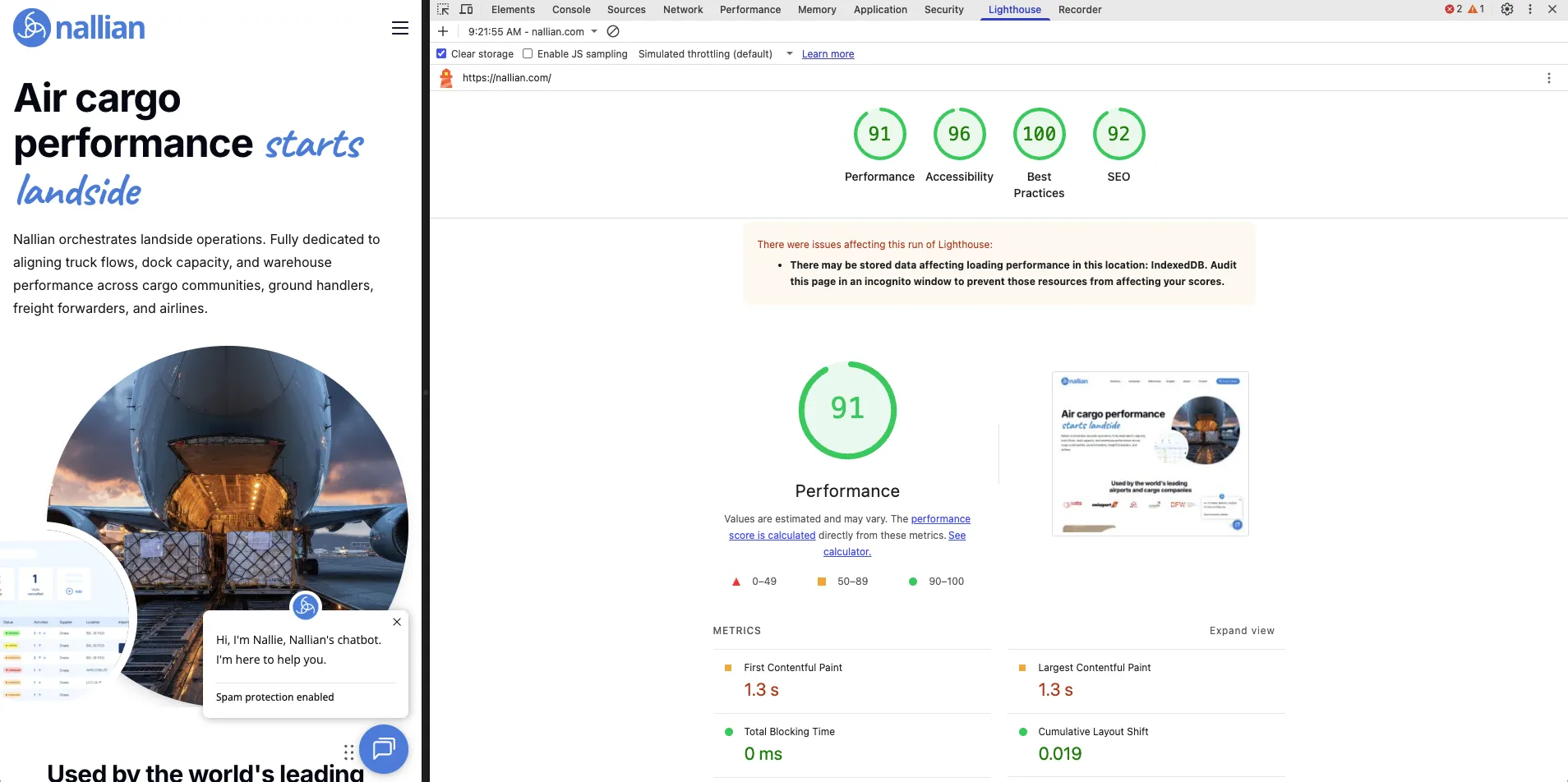
The old Joomla site scored 61 in Google Lighthouse. We set a goal that most agencies would consider ambitious: above 95.
We reached 95.
What this means in concrete terms
Google Lighthouse is the standard tool that the search engine uses to evaluate the quality of a site according to four dimensions: performance, accessibility, best practices and SEO. A score of 95 out of 100 places Nallian's home page among the best performing sites in the B2B SaaS universe.
Concretely:
< 1 seconde
Homepage loading time on mobile and desktop, on average connections
+34 points
Measurable improvement on the Lighthouse scale, from 61 to 95
Le plus rapide
Faster than all of Nallian's direct competitors we tested
Why it matters to the business
A fast B2B site is not a vanity metric. This is a structural advantage on three fronts:
- Google ranks fast sites better. Speed has been a confirmed ranking factor since the introduction of Core Web Vitals. Nallian's competitors will need years to close this gap.
- Faster sites convert more visitors into leads. Industry studies consistently show a 7-20% conversion loss for every additional second of delay beyond 2 seconds. Nallian is now on the right side of this equation.
- Speed signals quality before the visitor reads a word. For the same reason that a well-lit, tidy store signals quality before you even look at a price tag.
Commitment three: total editorial autonomy
This is the engagement that mattered most to the long-term success of the site.
A nice, fast site that requires a call to the agency for every update is a nice, fast trap.
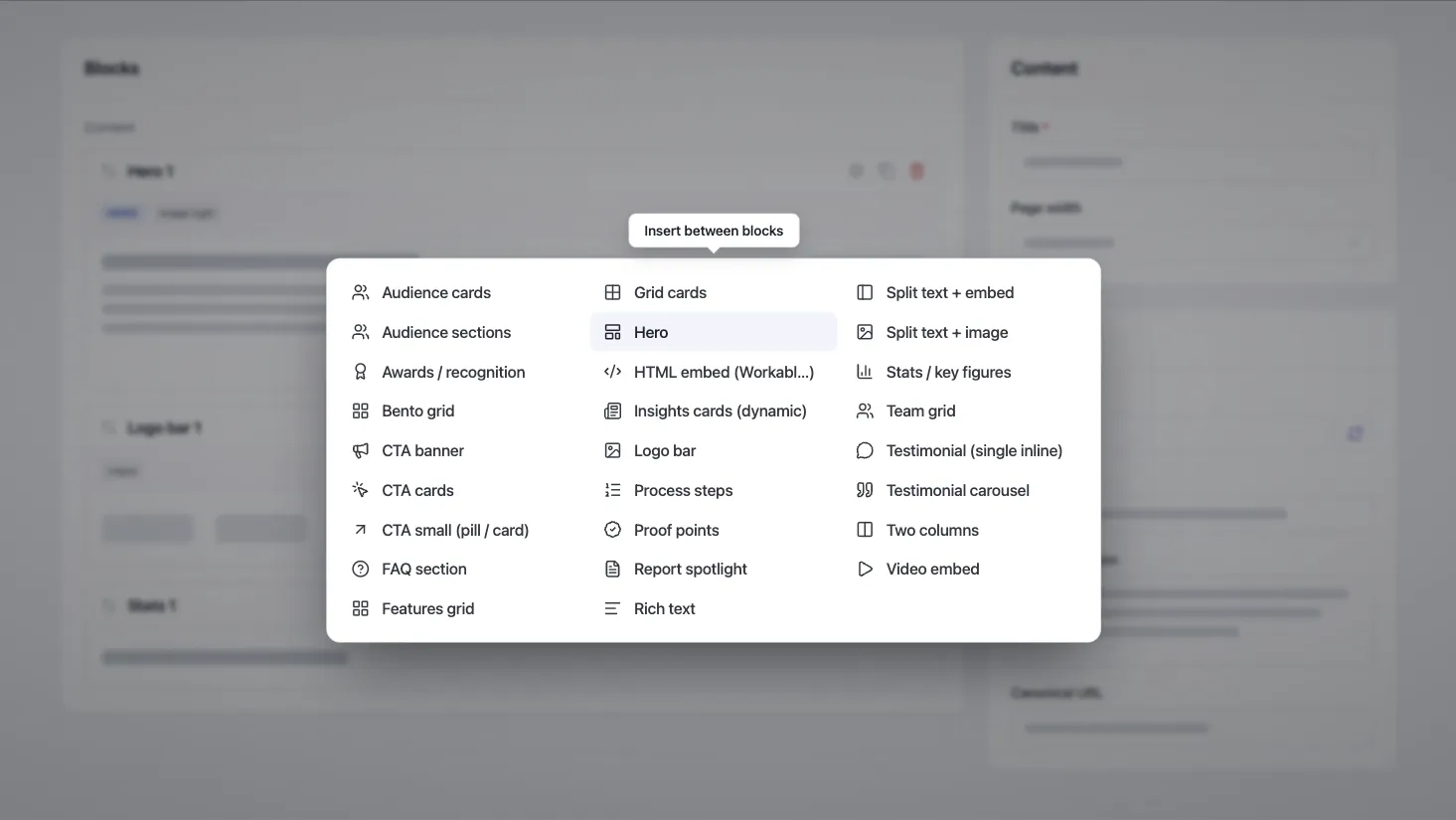
We built the new Nallian platform around a custom administration interface. Not a generic CMS. Not a WordPress with twelve plugins. Not a page builder with seventeen popups. A visual editor designed specifically for the way Nallian's marketing team actually works.
Here is what this changes, concretely:
- A library of ready-to-use sections. The editor chooses a type of section (hero, testimonial, feature grid, highlighting a case study), fills the text, uploads an image, publishes. No HTML. No plugins to configure.
- Preview before publishing, on every page. Any changes can be previewed in a private environment that renders the page exactly as it will be online, without ever risking the public version.
- Scheduled publication, on each page. Articles, press releases, product pages, everything can be scheduled for posting on a specific date and time.
- Complete version history with one-click backtracking, on every page. Each modification is saved. If a post contains an error, the editor is one click away from any previous version.
- One upload, all variations. When an image is uploaded once, the system automatically generates each variation the site needs (mobile, desktop, thumbnail, social sharing card) at the exact dimensions used on the site. No manual resizing.
The change this creates is not just operational. It transforms the relationship between the marketing team and the site. The site ceases to be a technical asset that lives within the agency to become an editorial surface that lives with the people who use it on a daily basis.
Where AI helped, and where it didn't belong
By 2026, any agency that claims to have built a site without using AI is either lying, obsolete, or both. Conversely, any agency that claims AI built it all is selling you a generic asset indistinguishable from ten thousand others.
We use AI where it makes us faster and more reliable. We don't use it where it would dilute the quality of what we deliver. Here is the honest assessment for the Nallian project.
| Area | Use of AI | Why |
|---|---|---|
| Strategic positioning | 0% | The strategy is the part for which you pay an agency. It cannot be delegated to a model who has never met the client. |
| Visual design | 0% | Every wireframe, every layout, every visual decision was made by a human designer working with Nallian's brand and audience in mind. |
| Editing of the site | 0% | All published content was produced by the Nallian team. We accompanied the structure, they wrote the words. |
| SEO and content architecture | 0% | The map of 166 keywords and the 13 thematic clusters were constructed manually, from SE Ranking data and our own analysis of the air cargo software universe. |
| Project management | 30% | Used to speed up the writing of briefs, meeting minutes and internal documentation. Human proofreading on each production. |
| Development | 50% | Used as a code assistant. We make architectural decisions, AI accelerates implementation. Each line is proofread, tested and committed by a human. |
| Content migration scripts | 100% | Disposable and one-time scripts to extract content from old Joomla. Perfect terrain for AI: technical, repetitive, with a deterministic result that can be verified. |
| Automated testing and CI/CD | 60% | Used to write and maintain the test suite. The CI/CD pipeline itself was designed by humans, with AI speeding up the writing of individual test cases. |
| Technical documentation | 80% | Used massively to produce internal and customer technical documentation, which the AI manages well because the format is structured and repetitive. |
| Customer communication | 0% | Every conversation with Nallian, every email, every report shared with the customer was written by a human. AI has no place in customer relations. |
The pattern, if you look at it carefully, is consistent: AI accelerates technical, internal, structured work. It never replaces strategic, creative or relational work.
This is why Nallian’s site doesn’t look like an AI-generated template. Because he isn't.
How we worked together
Three months from launch to going online, with a firm deadline (June 3, 2026) and a team spread across two countries. This is how we structured the project.
- Audit and Discovery. What the Nallian team actually does on a daily basis, what frustrated them on the old site, what the sales team needed from the new one, what the competitive landscape for air cargo software looked like. 2. Content architecture and SEO strategy. Before designing a single page, we redesigned the entire structure of the site: navigation, page templates, content types, SEO clusters. We mapped 166 strategic keywords into 13 thematic clusters, and decided which page would carry which conversation. 3. Iterative design. Each page was designed, reviewed with the Nallian team and refined before going into development. No big reveal at the end. No “this isn’t what we expected” moment. Just a steady accumulation of validated pages. 4. Automated development, testing and content migration. We built the platform on Laravel, Filament and Livewire, with a fully tested and validated CI/CD pipeline that automatically lins, tests and deploys every change. We automatically migrated existing content from the old Joomla: articles, press releases, events, case studies. No copy-pasting, no lost content, no broken links. 5. QA and uploading. Cross-testing, training of the Nallian team to the new admin, uploading on the scheduled date.
The site was put online on Wednesday June 3, 2026, on time.
What was delivered
A custom platform on a modern and maintainable stack. No plugins, no themes, no dependencies that break six months later.
- Lighthouse score increased from 61 to 95 on home page
- Loads in less than a second on mobile and desktop
- Existing legacy content automatically migrated from old Joomla
- A back office that works on mobile
- 100% d'autonomie éditoriale pour l'équipe Nallian
- Preview and version history available on each page of the site
- Scheduled publishing available on each content type
- A fully tested and validated CI/CD pipeline
- 0 third-party plugins, each feature developed specifically for Nallian
What Joke said about our collaboration
When we asked Joke at the end of the project what made her choose Numinam, this is what she wrote:
I have already worked with the founder of Numinam in the past. I know he is someone who thinks with you, strategically and creatively, and who will always seek to deliver a high-quality, high-impact result. He is easy to work with. Communication is clear and fast, deadlines are met, and he finds solutions to challenges that arise along the way.
Joke Aerts
Directrice Marketing, Nallian
What we learned (and what you can learn from it)
If you're considering a B2B site redesign for your own business, here's what this project confirmed for us. The short version of what we would say to you over coffee.
- A custom B2B site costs more initially. It costs much less over time. No plugins that break, no theme incompatibility every six months, no calls to the developer for each adjustment. Over a period of three to five years, the total cost of ownership of a custom site is systematically lower than that of the “cheap” template alternative. 2. Site speed has become a strategic asset. Google knows it, your prospects feel it. A slow site discredits even a premium offering. If your current site loads in more than 2 seconds, you're losing leads you'll never know about. 3. Editorial autonomy is a productivity multiplier. When a marketing team is not waiting for an agency to publish, the volume of content produced increases significantly. The cumulative effect on SEO, social proof and pipeline is real. 4. Custom-made is not a luxury. It's an investment. Especially when your site is your primary lead generation channel or first business impression. The opportunity cost of an underperforming B2B site is almost always greater than the cost of fixing it properly.
Joke summed it up better than we could have:
Do your homework. Clarify for yourself what you want to accomplish with your site, the story you want to tell, and the experience you want to provide to your users. Then choose an agency or service provider who understands what you need and who thinks with you.
Joke Aerts
Directrice Marketing, Nallian
That last part, “think with you,” is the real test. If the agency you're talking to doesn't ask better questions than you, keep looking.
Frequently asked questions
What is a B2B site redesign?
How long does a B2B site redesign take?
How much does a custom B2B site cost?
What is the difference between a custom site and a template site?
Did you use AI to build the Nallian site?
What is the difference between a custom site and an AI-generated site?
What is a good Google Lighthouse score for a B2B site?
What is the ROI of a B2B site redesign?
How to choose a B2B website redesign agency?
Looking for technical details?
This page tells the business story of the project. If you have a technical profile and want to understand the architecture, the stack, the performance choices, the content versioning system and the migration approach, contact us: we love talking tech among enthusiasts.
Is your B2B site holding you back?
If you recognize yourself in Nallian's story (a site that no longer corresponds to your level, a team blocked with each update, loading times that discreetly cost you leads), we would be delighted to discuss it.
We exist for one reason: to bridge the gap between what a business is and what its site shows. If this gap exists for you, we should talk.
Let’s talk about your project